Specialty guide · India
Dermatology, Venereology & Leprosy
Skin-disease demand, outpatient and procedural practice models, industry options and AI in image-based diagnosis.
Dermatology, Venereology & Leprosy as a career
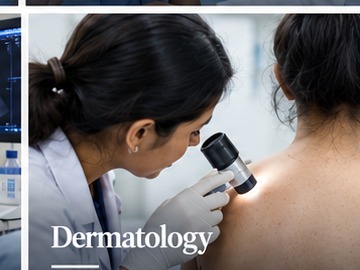
Dermatology is predominantly outpatient, visually intensive and relatively compatible with independent practice. Clinical dermatology, procedural dermatology, aesthetics, academic work, pharma and digital imaging create distinct career models.
Clinical demand
Skin disease contributes substantial morbidity in India, with infectious, inflammatory, pigmentary and chronic skin conditions all contributing to the case mix. The strongest demand signal is broad outpatient burden rather than one single disease category.
Demand source: open source
Work settings
| Setting | Typical role | Main constraint |
|---|---|---|
| Government / public hospitals | General dermatology, STI/leprosy programs, tertiary referral and teaching. | Public demand exists but specialist distribution is uneven. |
| Private hospitals | Consultant dermatology and procedural work. | Brand and procedure mix influence economics. |
| Independent practice | Clinic-based dermatology, procedures and, where chosen, aesthetic services. | Competition, equipment choices and reputation are key. |
| Academia / research | Teaching, inflammatory skin disease, immunology and clinical trials. | Research infrastructure varies. |
| Pharma / devices | Biologics, immunology, anti-infectives, dermocosmetics, lasers and medical affairs. | Strong industry interface. |
Practice economics
Dermatology can support a relatively low-footprint clinic, but procedural and aesthetic models can become equipment intensive. Economics vary widely between medical dermatology and cosmetic practice. No national earnings range should be inferred from urban aesthetic clinics.
No generic salary range is shown unless a dated source supports the role, geography and sector.
Training capacity
State and college counts are shown only where the source rows can be checked exactly.
Higher-training and focused routes
Eligibility rules can change. The current NMC/NBEMS/NEET-SS bulletin governs formal feeder eligibility.
Research, industry and teaching
AI applications and workflow
Dermatology is highly exposed to image-based AI because classification and triage can be trained from photographs and dermoscopic images. Current reviews show strong performance in narrow tasks but persistent limitations in dataset diversity, bias and real-world implementation. Procedural care, complex inflammatory disease and contextual diagnosis remain clinician dependent.
Regional variation
Reliable state-level skin-disease comparisons are less consistent than for diabetes or maternal health. State comparisons are therefore limited to GBD or state studies with comparable methods.
Disease burden, workforce, infrastructure and private-market conditions are reported separately; one is not used as a proxy for another.
Regional figures: open source
Current openings
Links open external job searches. Listings change continuously.
More current opportunities →